Every wedding season, venues, rental companies and event planners set up millions of seats — and a large share of those chairs comes from China. Foshan, in Guangdong's Pearl River Delta, is the world's densest furniture manufacturing cluster, where chair factories, raw-material suppliers and export logistics sit within a few kilometres of each other.
BanquetJoy manufactures wedding and event chairs in a 30,000-square-meter Foshan factory with annual capacity of 500,000 chairs, shipping to 60+ countries. This guide covers why global buyers source wedding chairs from China, how the mainstream chair styles compare, what prices and MOQs to expect, and how to verify a supplier before you wire a deposit.
Why the World Sources Wedding Chairs from China
China produces the majority of the world's event and wedding chairs, and Foshan's Shunde district is the centre of gravity. The Lecong furniture market alone stretches for kilometres, and the surrounding industrial towns host thousands of chair factories, component workshops and finishing plants.
Three structural advantages keep global buyers coming back:
- A complete supply chain in one cluster: steel and aluminium tubing, resin and polycarbonate, powder coating, electroplating, cushion foam and upholstery fabric are all sourced within roughly 50 km, which shortens lead times and cuts component costs.
- Scale-driven pricing: high-volume production lines spread tooling and labour costs across millions of chairs, so container buyers get per-unit prices that smaller manufacturing regions cannot match.
- Export infrastructure: the ports of Guangzhou and Shenzhen sit about an hour from the factory cluster, with weekly sailings to every major market and a deep pool of freight forwarders and customs brokers.
The cost gap is concrete. A steel chiavari chair that retails for US$40-60 in Western markets leaves a Foshan factory at a fraction of that price at container volume, and even after freight, duties and local delivery, importers typically land chairs at 40-60% below domestic wholesale. That spread is what funds a rental company's fleet growth or a distributor's margin.
For wedding industry buyers, the result is simple: the world's widest choice of wedding chair styles, at wholesale prices that protect rental and resale margins.
Mainstream Wedding Chair Styles: A Buyer's Guide
Four chair families dominate global wedding and event buying. Each serves a different look, venue type and price point:
| Style | Typical Materials | Look & Best Use | Stacking | Reference FOB Price* |
|---|---|---|---|---|
| Chiavari | Steel, aluminium or resin | Classic ballroom and banquet look; the default wedding rental chair | 8-10 high | US$8-20 |
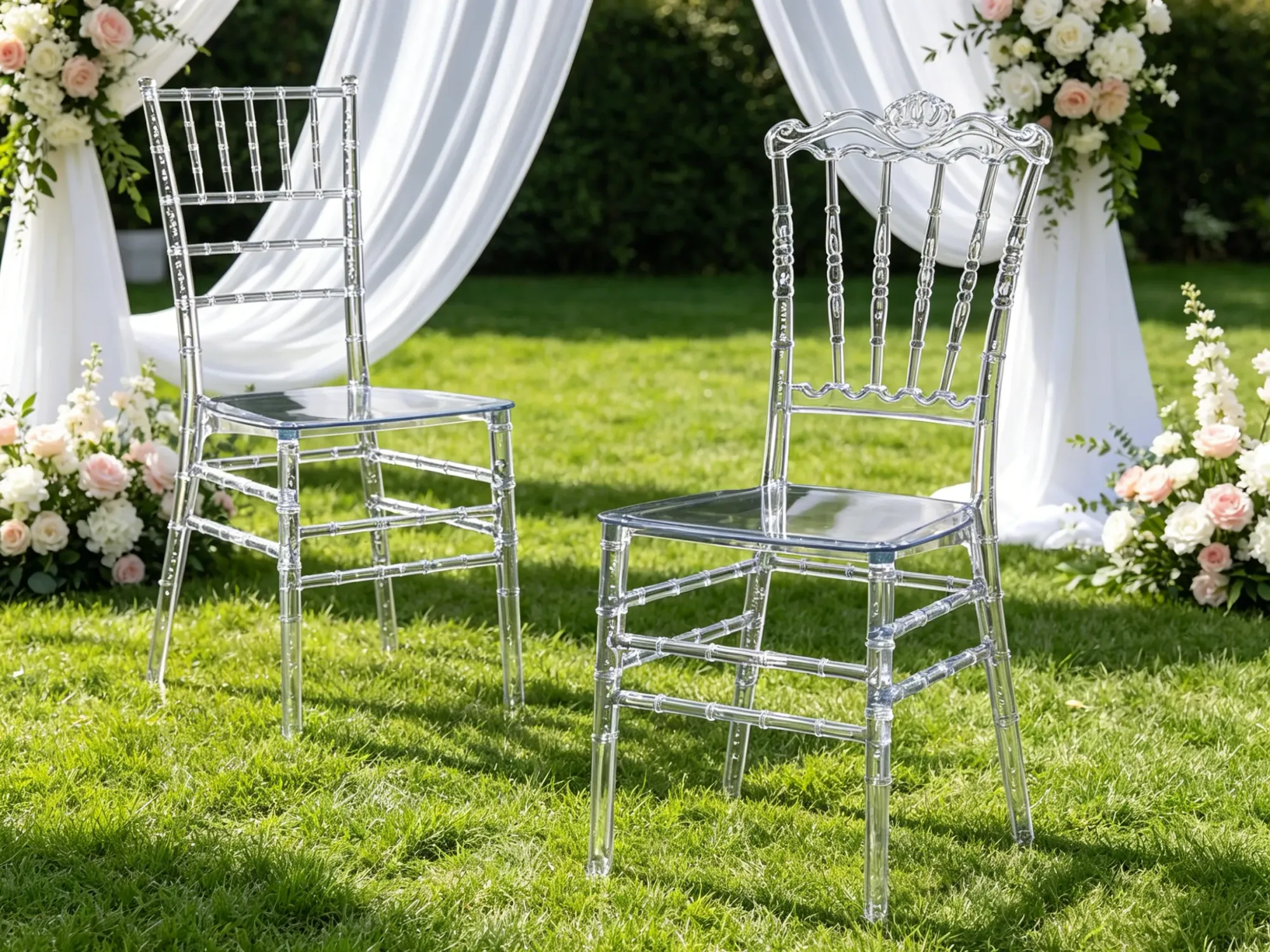
| Ghost (clear acrylic) | Polycarbonate | Modern, transparent; premium weddings and contemporary venues | 6-8 high | US$15-35 |
| Crossback | Wood or resin | Rustic barn, vineyard and outdoor weddings | 8-10 high | US$10-25 |
| Napoleon | Steel or aluminium | Versatile banquet style for hotels and venues | 8-10 high | US$8-18 |
*Reference ranges for standard specifications at container quantity. Prices move with materials, finish and order volume, so treat all figures as indicative and confirm at quotation.
How to choose: rental companies usually anchor fleets on chiavari chairs for volume, then add ghost chairs for the premium segment and crossbacks for rustic venues. Hotels and banquet halls tend to standardise on chiavari or Napoleon chairs in house colours, with cushions matched to the interior. If you serve mixed segments, a mixed container across two or three styles spreads risk and lets you test demand in your market.
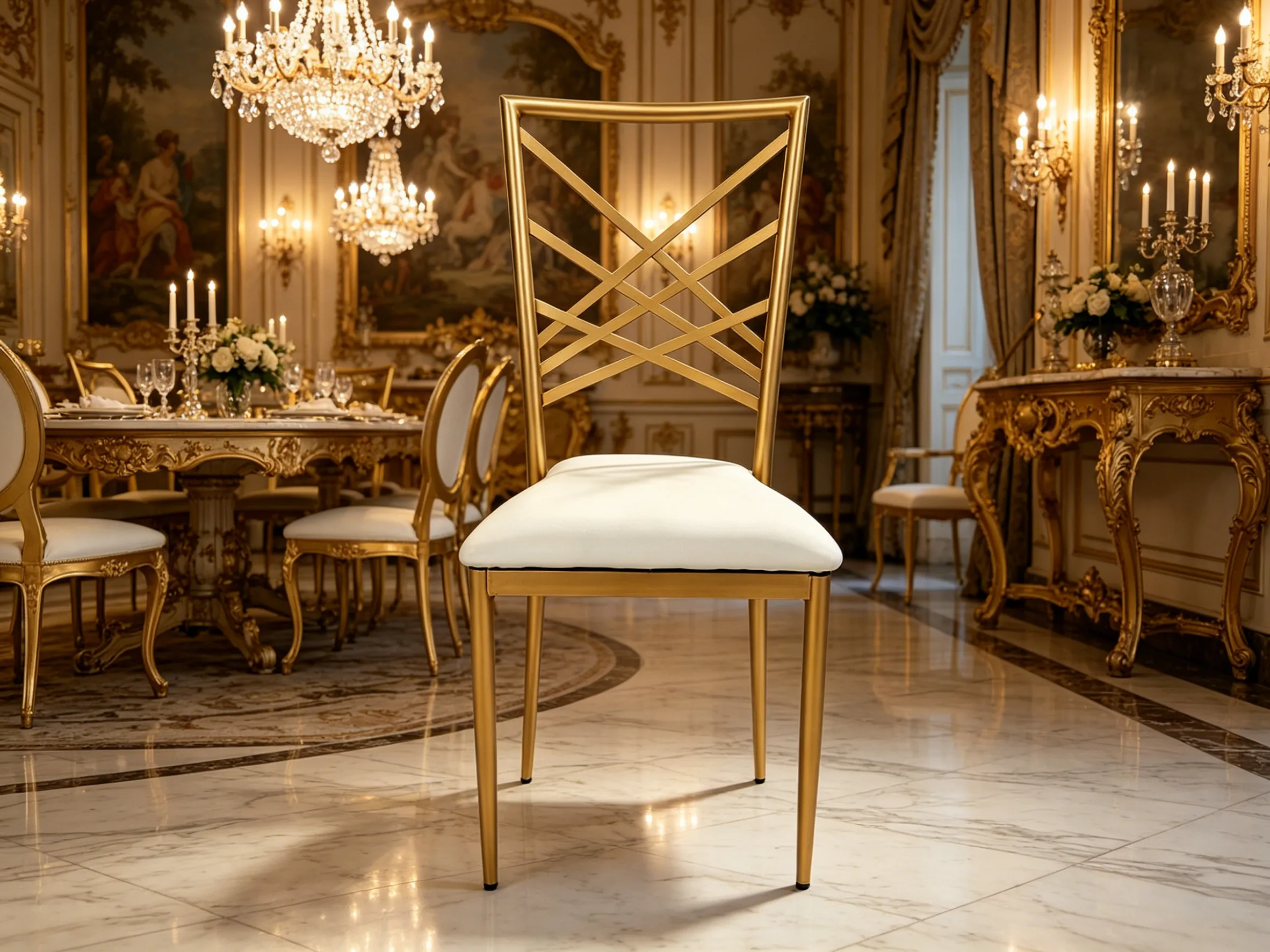
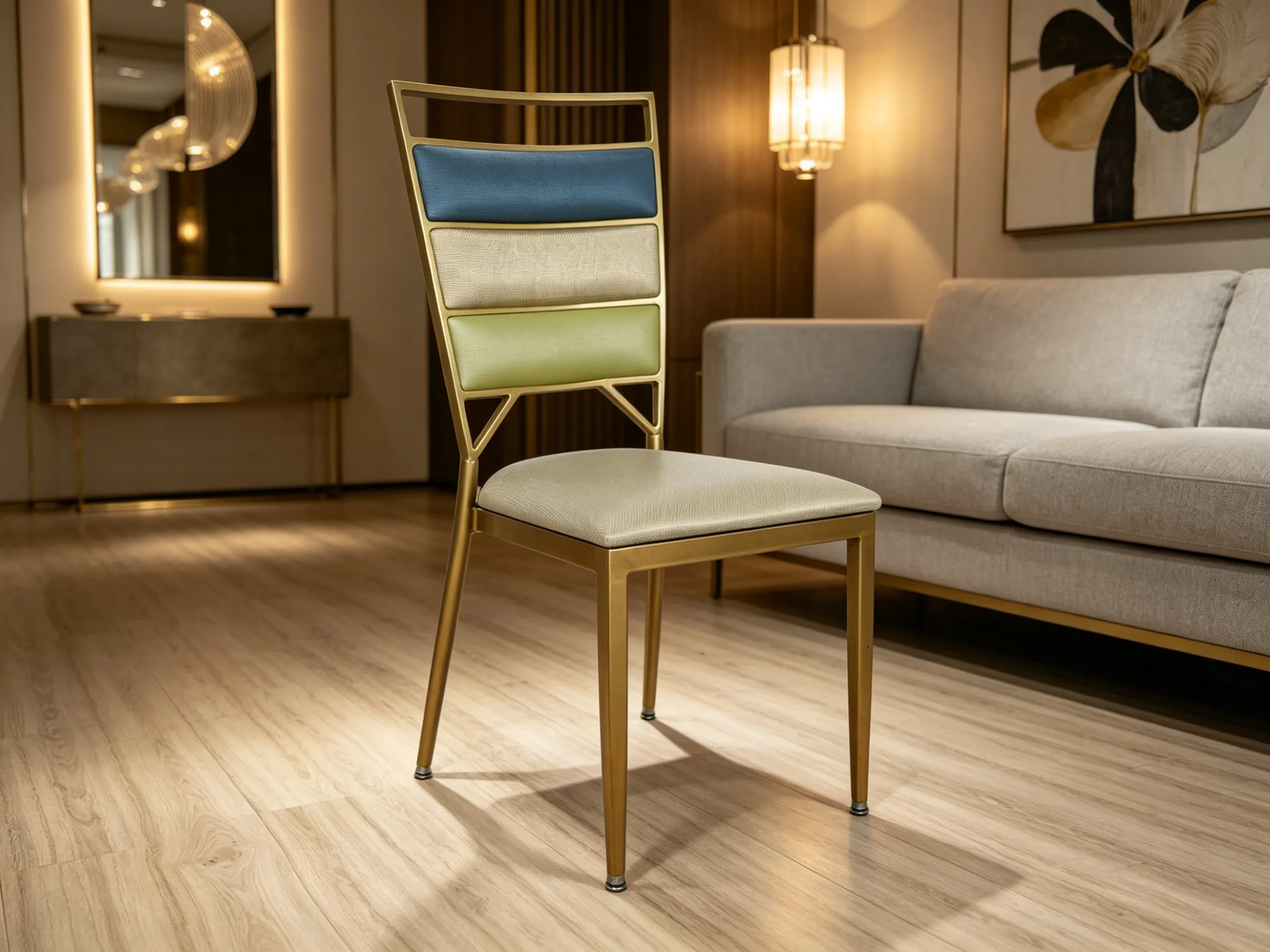
All four styles accept custom finishes — gold, silver, white, black, rose gold, limewash — plus fixed or velcro seat cushions, so one container can carry several colourways for different customer segments.
Wholesale Price Ranges & MOQ
Wedding chair pricing is driven by four variables:
- Frame material: steel is the value option; aluminium costs more but resists rust and weighs less; resin and polycarbonate sit in between;
- Finish: powder coating is standard; electroplated gold, limewash and wood-effect finishes add cost;
- Cushions: fixed cushions, velcro cushions and upgraded foam densities each shift the unit price;
- Order volume: full-container orders price meaningfully better than LCL trial shipments.
Standard MOQ is 100 pieces per model and colour, and mixed models can share one container — a practical way to build a varied fleet in a single shipment. First-time buyers often start with samples or an LCL trial order before committing to a 40HQ, which typically loads roughly 1,200-2,000 stacked chairs depending on the model.
Freight is quoted per shipment and fluctuates with carrier capacity and season, so any freight figure you see — here or elsewhere — is reference only and must be confirmed with your forwarder at booking.
How to Verify a Chinese Wedding Chair Supplier
The gap between a reliable factory and an expensive mistake is closed with basic due diligence:
- Confirm it is a real factory: ask for the business licence and a video walkthrough of welding, coating and assembly lines — a manufacturer can show production in progress, a trading company usually cannot;
- Check export history: ask which markets the factory ships to, and request anonymised bill-of-lading or container-loading references for your region;
- Order samples first: test weight, weld quality, stacking, finish and cushion density in hand before any deposit on bulk production;
- Use third-party inspection: for first container orders, an independent pre-shipment inspection (AQL sampling) costs a few hundred dollars and catches problems while they are still cheap to fix;
- Visit or video-call: if travel is impractical, a scheduled live video audit of the production floor and warehouse is a workable substitute.
Equally, watch for the classic red flags: prices far below the market range, reluctance to show production on live video, pressure to pay 100% upfront, contracts issued under a different company name than the business licence, and quotations that arrive suspiciously fast with no questions about your specifications. None of these proves bad intent on its own — but two or more together usually mean you are dealing with a middleman posing as a factory, or worse.
BanquetJoy welcomes all of the above — factory tours in Foshan, live video audits, sample orders and third-party inspections before shipment.
Ordering Process & Wedding-Season Timeline
A typical wholesale order runs on this track:
- 1. Inquiry & quotation: send models, colours, quantities and destination port; a detailed quote follows within 24-48 hours;
- 2. Samples: express courier in about 7-10 days; the sample fee is credited against the bulk order;
- 3. Contract & deposit: a proforma invoice fixes specifications and terms; production starts on receipt of a 30% T/T deposit;
- 4. Production: 20-25 days for most orders, with progress photos on request;
- 5. Inspection & balance: pre-shipment QC with photos and video (third-party inspection welcome), then the 70% balance by T/T;
- 6. Shipment: booking, container loading with photo records, and documents released to your broker.
Plan for roughly 6-9 weeks from deposit to arrival: 20-25 days of production plus 2-5 weeks of sea freight depending on destination, plus customs clearance. For peak wedding season — spring and autumn in most Western markets — place orders three to four months before your first big weekend. Rental companies refreshing fleets for a May season, for example, should be signing proforma invoices in January or February.
For shipments too small for a full container, LCL (less-than-container-load) service consolidates your chairs with other cargo at a modest premium per unit — a sensible bridge for trial orders. Full containers, by contrast, are loaded and sealed at the factory and opened only at your warehouse, which reduces handling damage on painted and plated finishes.
Why Buyers Choose BanquetJoy
- True factory-direct pricing: a 30,000-square-meter manufacturer, not a middleman — the margin stays in your business;
- Full wedding range: chiavari, ghost, crossback and Napoleon chairs in standard and custom finishes, produced in one factory for consistent colour and quality across styles;
- OEM/ODM flexibility: custom colours, cushion fabrics, foam densities and branded packaging for your fleet or distribution line;
- Documented quality control: incoming material checks, weld and finish inspection, weight-capacity and stacking tests, plus pre-shipment photo and video reports; third-party inspection welcome;
- Proven export record: annual capacity of 500,000 chairs shipped to 60+ countries, with packing and documentation practices proven on routes worldwide.
Payment is by T/T — 30% deposit, 70% balance before shipment — and repeat orders ship with identical specifications season after season, so your fleet stays consistent as it grows.