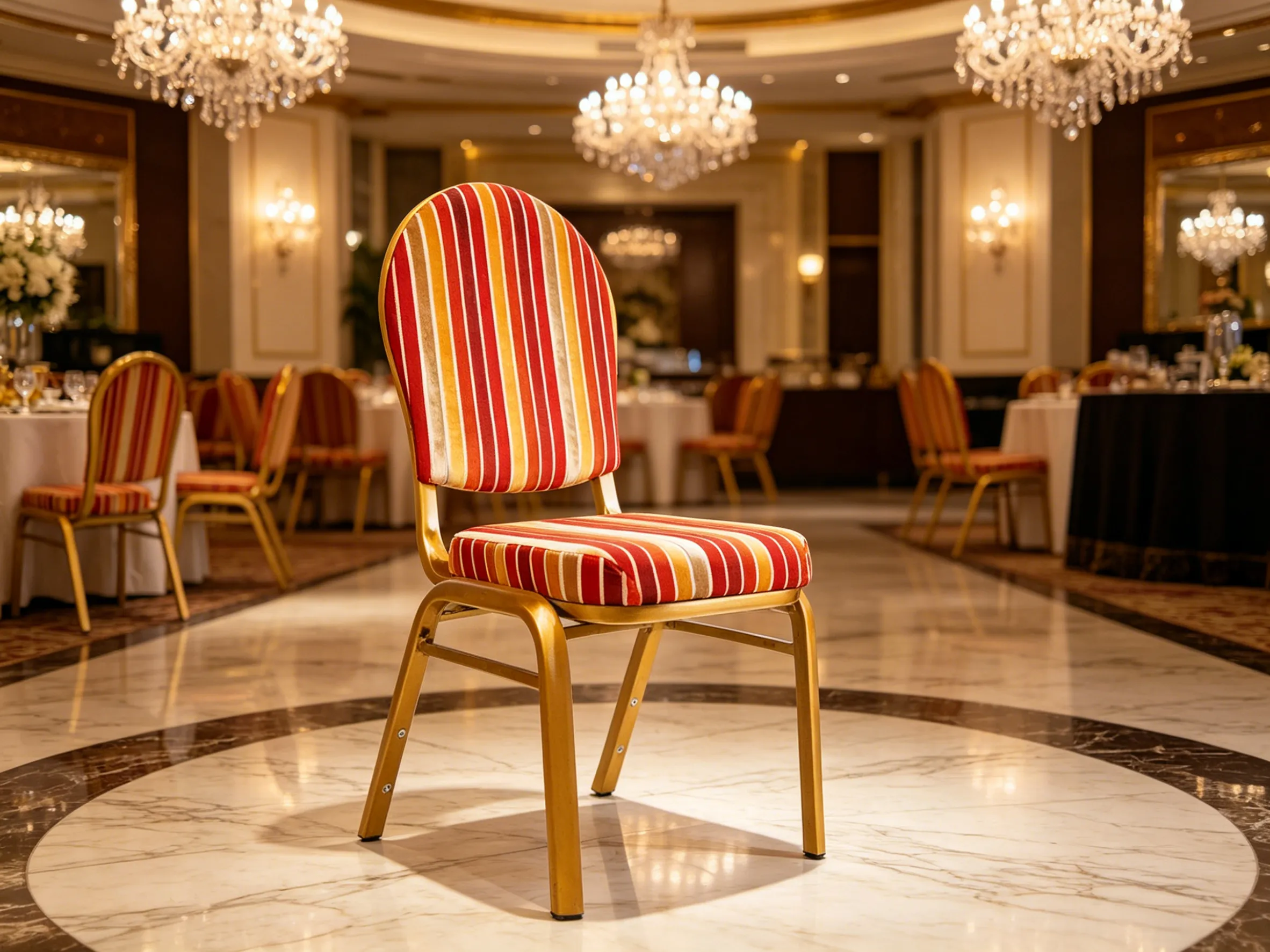
Choosing the right banquet chair manufacturer decides your margin, your quality ceiling and your headache level for years. Buy well and you get consistent chairs at factory prices, season after season; buy badly and you inherit wobbling frames, peeling finishes and an inbox full of complaints from venue managers.
BanquetJoy is a banquet chair manufacturer in Foshan, China — 30,000 square meters of production, annual capacity of 500,000 chairs, exporting to 60+ countries. This guide explains how factory-direct sourcing differs from buying through trading companies, how to audit a manufacturer, when to choose OEM versus ODM, and the contract and payment practices that protect your money.
Manufacturer vs Trading Company: The Real Difference
China's banquet chair supply comes through two channels: factories that make chairs, and trading companies that resell them. Traders have their place — small mixed orders, multi-category sourcing — but for volume banquet chair buying, the differences are structural:
| Dimension | Direct Manufacturer | Trading Company |
|---|---|---|
| Pricing | Factory-gate price; typically 10-30% lower at container volume | Factory price plus markup, often opaque |
| Quality control | Your specifications go straight to the production line; issues are fixed at the source | Specs relayed through a middleman; fixes negotiated, not commanded |
| Customization | OEM/ODM done in-house: frames, finishes, cushions, packaging | Limited to what the underlying factory agrees to |
| Communication | Direct access to engineers and production planners | Messages relayed; details lost between parties |
| Accountability | One contract, one responsible party | Responsibility split between trader and factory |
At a 1,000-chair scale, even a modest per-chair markup adds up to thousands of dollars — money that would otherwise fund your inspection budget or your profit. And when a finish peels six months in, a manufacturer owns the problem; a trader can only forward your email.
To be fair, trading companies earn their markup in specific situations: consolidating small orders across many product categories, or serving buyers whose volumes sit below factory MOQs. But banquet chairs are a volume game. Once you buy 500 or more chairs per order, factory-direct is almost always the better structure — and a supplier's willingness to show its production line is the quickest way to tell which one you are actually talking to.
How to Audit a Banquet Chair Manufacturer: A Buyer's Checklist
Serious manufacturers expect to be audited. Work through this checklist before signing anything:
- Legal identity: business licence and export records under the same company name that will appear on your contract and invoice;
- Capacity: factory floor area, workforce and monthly output versus your order size — a 500-chair order needs a different line than a 50,000-chair programme;
- Production lines: tube cutting and bending, welding jigs, powder-coating or plating lines, cushion cutting and sewing, assembly and packing — every in-house step is one less outsourced risk;
- Quality control process: incoming material checks, in-line inspection at welding and coating, and pre-shipment checks for weight capacity, stacking and finish; ask for sample QC reports from real orders;
- Export track record: markets served, anonymised container-loading photos or bill-of-lading references, and how long the factory has shipped to your region;
- Documentation practice: proforma invoices with full specifications, and standard export documents (commercial invoice, packing list, bill of lading).
Red flags during an audit: a showroom with no production behind it, reluctance to demonstrate live welding or coating, QC reports that look templated rather than order-specific, and export references that cannot be verified. A factory with nothing to hide will let you look anywhere — including the raw-material yard and the reject pile.
BanquetJoy supports on-site audits at our Foshan factory and live video walkthroughs of every line listed above.
OEM vs ODM: Choosing the Right Model
Three letters decide who designs your chair:
OEM (Original Equipment Manufacturing): you bring the specification — dimensions, tube thickness, finish colour, cushion fabric, packaging — and the factory builds to it. OEM suits buyers with an established product line: distributors protecting a brand, hotel groups matching an existing fleet, rental companies replicating a proven chair.
ODM (Original Design Manufacturing): the factory brings proven designs and you brand and fine-tune them. ODM suits buyers entering a market fast: pick a validated banquet chair platform, choose finishes and cushions, add your cartons and labels, and go to market without paying for tooling or absorbing design risk.
In practice, most orders blend the two: a factory's standard frame with your colour, your cushion specification and your branding. The questions that matter are whether the factory can hold your specification consistently across 1,000+ chairs, and whether reorders arrive identical to the first batch. BanquetJoy runs both models and locks specifications into the proforma invoice so every repeat order matches the last.
Cost-wise, OEM and ODM differ mainly in who pays for development. OEM with new tooling — custom jigs, moulds or dies — carries one-off setup costs amortised over your order volume, while ODM on existing platforms starts at zero tooling cost. Either way, custom colours and cushion fabrics usually add little beyond material cost at container quantities.
Factory Visits, Video Audits & Third-Party Inspection
Distance is no excuse for buying blind. Three layers of verification fit any budget:
- Factory visit: nothing beats walking the floor — watch weld quality on live production, check coating adhesion, sit on finished chairs, and look at raw-material stock and the packing area. Combine the visit with Foshan's furniture markets to calibrate your pricing expectations.
- Live video audit: a scheduled video call that walks the production line, warehouse and QC station in real time. Unlike a polished marketing video, you choose where the camera goes.
- Third-party inspection: independent QC companies perform pre-shipment inspections using AQL sampling — checking workmanship, dimensions, weight capacity and carton condition — typically for a few hundred dollars per inspection. Book one for your first orders with any new supplier.
Every inspection cost is small against the price of a bad container. We welcome all three layers, and provide our own photo and video QC reports before every shipment.
Contracts, Payment Terms & Lead Times
Standard practice in Chinese furniture exporting is well established — deviations from it are a red flag:
- Proforma invoice first: model numbers, materials, finishes, quantities, unit prices, Incoterms and lead time in writing before any money moves;
- Payment: 30% T/T deposit to start production, 70% balance before shipment, after inspection. Treat demands for full prepayment from a new supplier as a warning sign;
- Production lead time: 20-25 days for most banquet chair orders after deposit;
- Sea freight: roughly 2-5 weeks port-to-port depending on destination — about 14-20 days to the US West Coast, 25-35 days to the US East Coast and major European ports, less within Asia. Rates fluctuate with season and carrier capacity, so all figures are reference only and confirmed at booking;
- Total cycle: plan 6-9 weeks from deposit to arrival, plus customs clearance.
Risk control is procedural: approve samples before bulk production, inspect before paying the balance, and keep specifications inside the contract so any dispute has a written reference. After the first order, repeats become routine — same specification, same price basis, predictable lead time.
Incoterms define where factory responsibility ends: EXW puts all logistics on you from the factory gate; FOB (Guangzhou/Shenzhen) covers delivery onto the vessel; CIF adds ocean freight and insurance to your destination port. First-time importers usually find FOB or CIF the simplest structure, with a local broker handling customs clearance at destination.
Why Buyers Choose BanquetJoy
- A real manufacturer: 30,000 square meters of production in Foshan, with tube processing, welding, coating, cushion and packing lines you can audit on-site or by live video;
- Capacity that scales with you: annual capacity of 500,000 chairs, from 100-piece trial orders to multi-container programmes;
- OEM and ODM under one roof: custom frames, finishes, cushions and branded packaging, with specifications locked so reorders match;
- Documented quality control: incoming, in-line and pre-shipment checks, weight-capacity and stacking tests, and photo and video reports with every order; third-party inspection welcome;
- Proven exporter: banquet chairs shipped to 60+ countries, with packing and documentation practices proven on routes worldwide.
Payment is by T/T — 30% deposit, 70% balance before shipment — and our export team replies to inquiries within 24-48 hours with pricing and a production plan.
Recommended Products
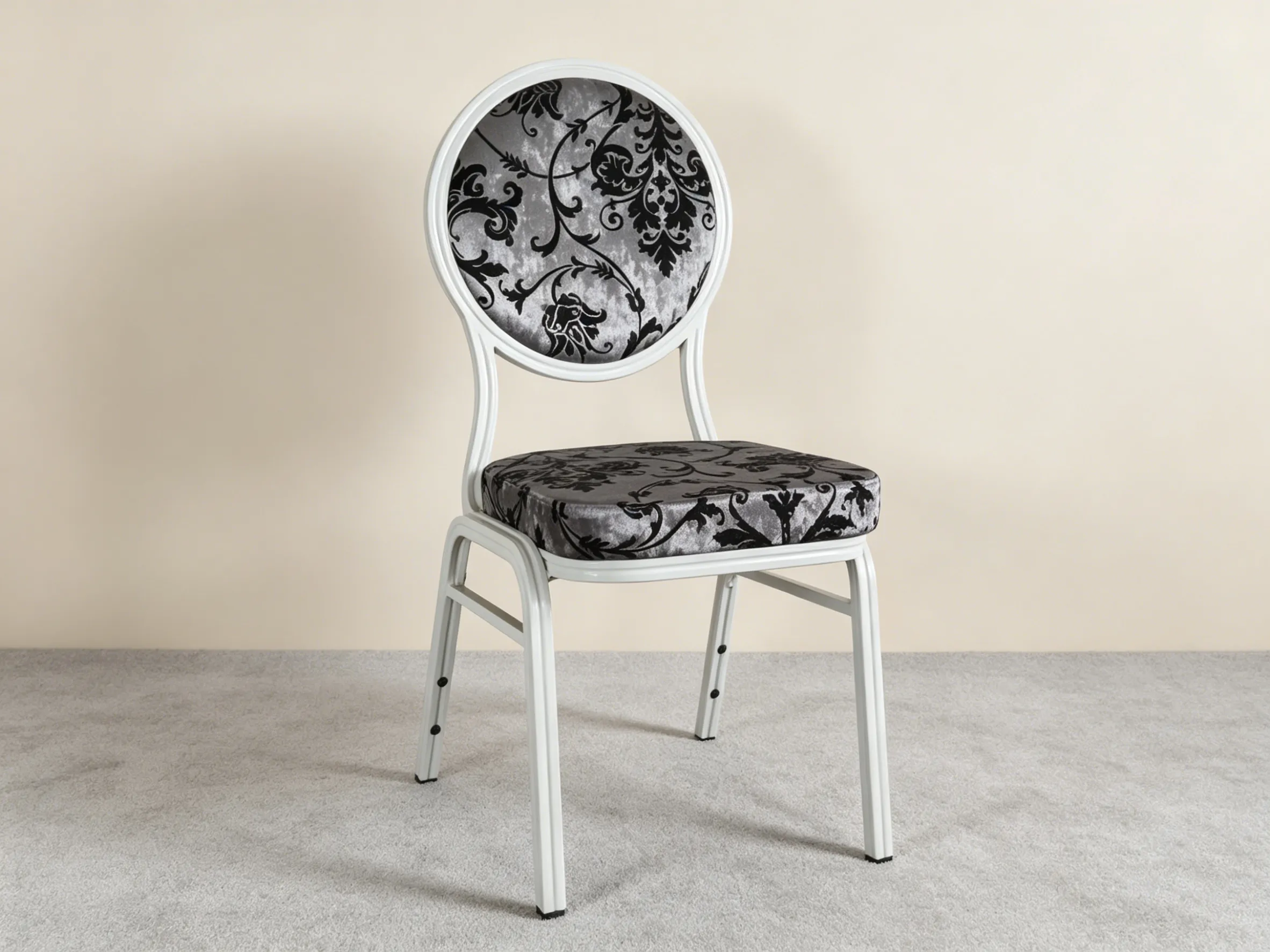
Simple and Elegant Banquet Chair - Iron Frame Hotel Seating
Contact for Price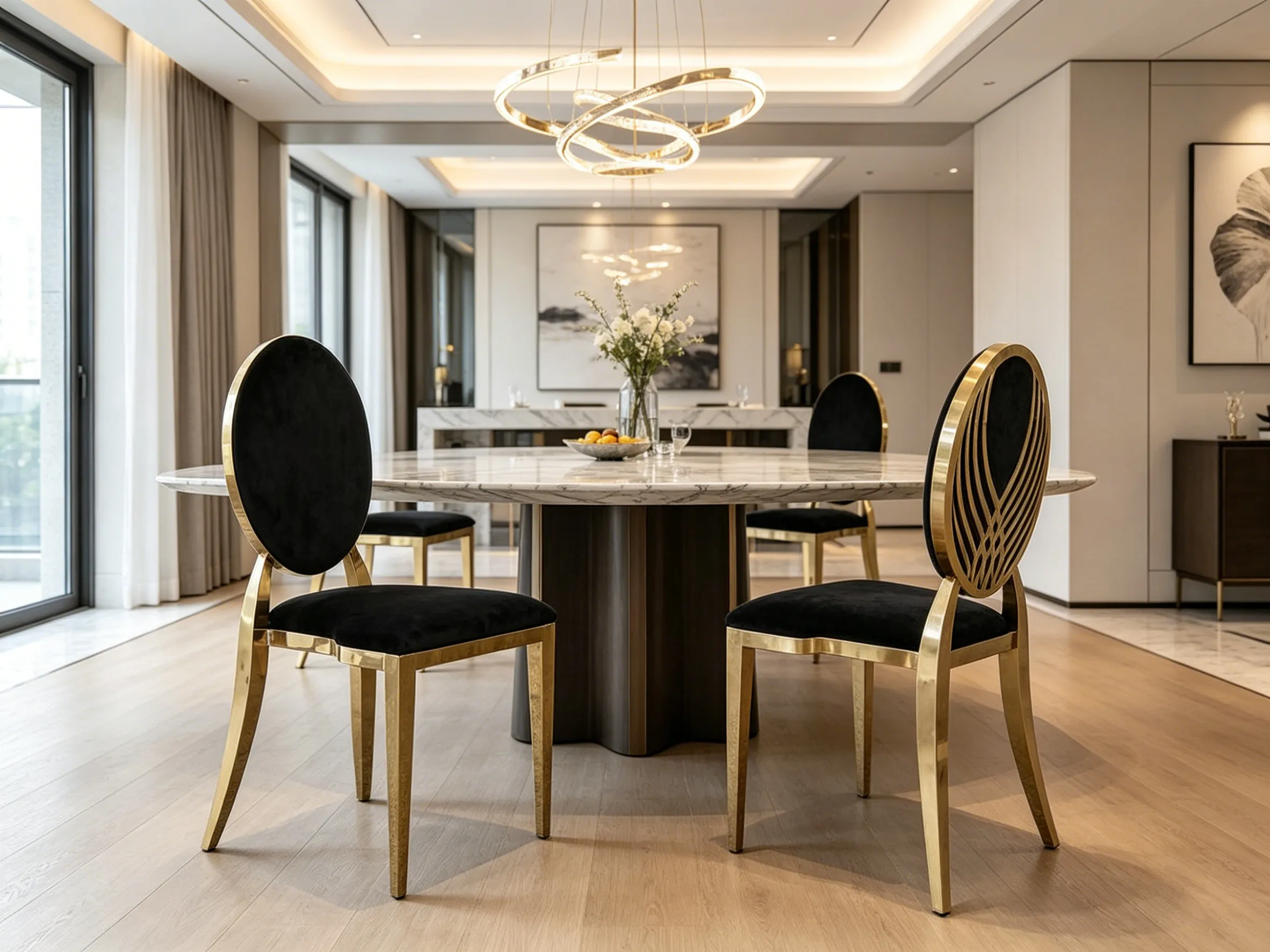
Stainless Steel Banquet Chair - Commercial Grade Durability
Contact for Price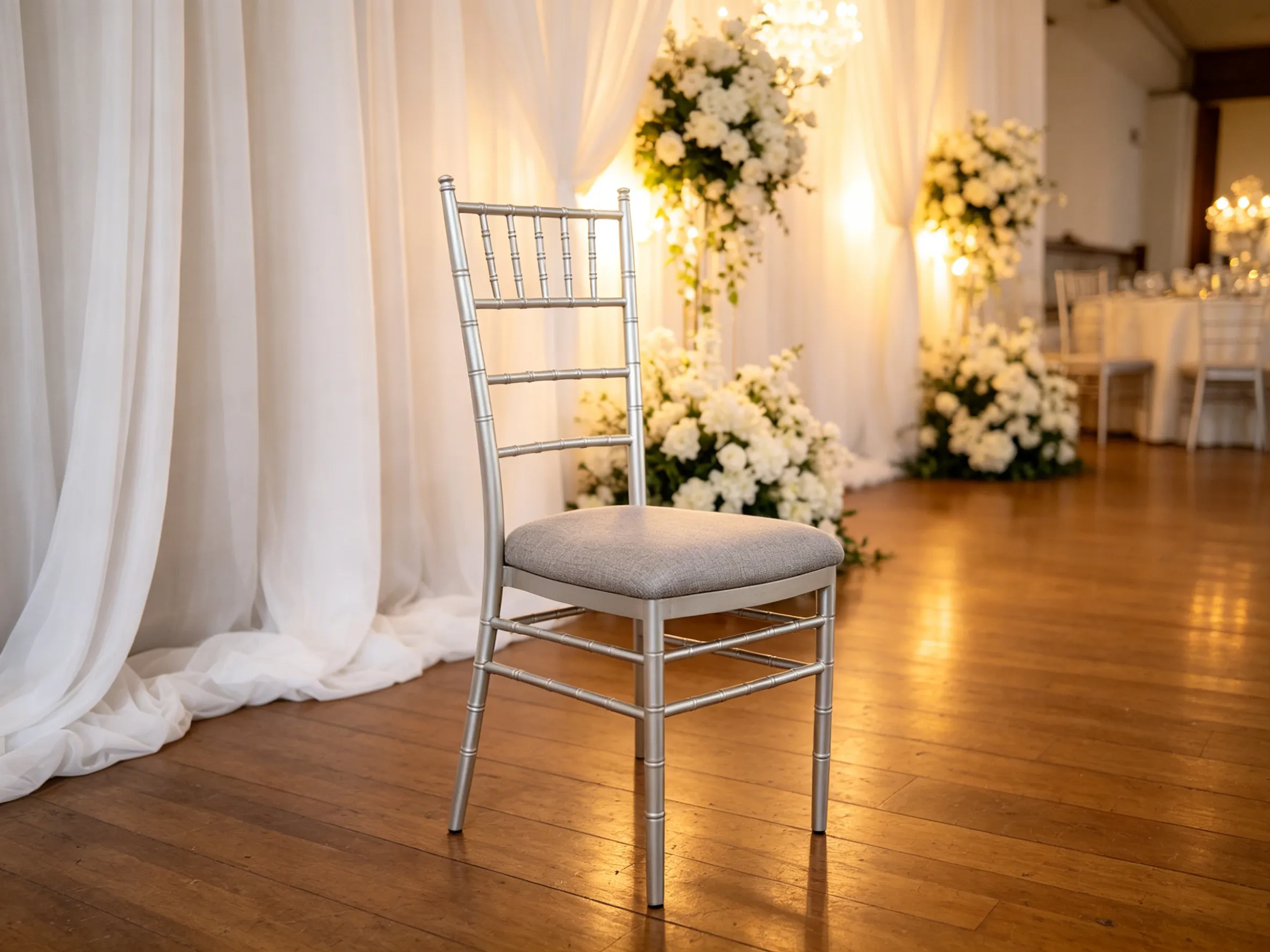
Classic Chiavari Chair - Lightweight Wedding & Banquet Favorite
Contact for Price